
What is Dry Rot?
Dry Rot Explained
Dry rot is a serious form of timber decay caused by the fungus Serpula lacrymans. Despite its name, dry rot needs moisture to grow. It is usually linked to damp building defects such as leaks, poor ventilation, blocked gutters, defective pointing or hidden water ingress.
Dry rot can damage structural and decorative timbers if it is not identified and treated correctly. It can affect floors, skirting boards, joists, lintels and other timber elements, particularly where damp conditions have allowed fungal growth to develop.
This page explains what dry rot is, how to recognise the warning signs, when to arrange a timber survey and how BT Preservation treats dry rot in Yorkshire homes.
True dry rot refers to one specific fungus: Serpula lacrymans. In timber reports, specialist surveyors may also refer to it as “True Dry Rot Fungus”. Accurate diagnosis matters because dry rot can be confused with wet rot or other forms of timber decay.
BT Preservation surveyors are experienced in identifying rot and timber infestations, so homeowners receive clear advice before any remedial work is recommended.
Also in this section
Identifying True Dry Rot
One of the main worries about dry rot is that it can actually be present for years before you notice any symptoms.
This means that often, by the time Dry Rot has been diagnosed, the damage can be quite substantial. However, there are signs to look out for, which are less spectacular than the garish fruiting bodies above.
Remember that without lots of water, Dry Rot cannot take hold. This means that often a specialist timber surveyor will find Dry Rot by following a ‘trail’ of dampness or damp-promoting building defects, in order to uncover a Dry Rot outbreak.
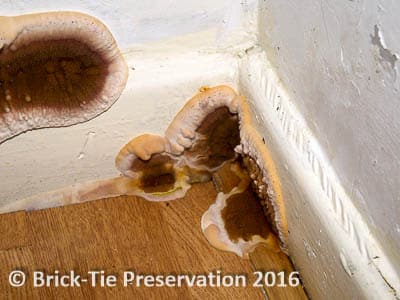
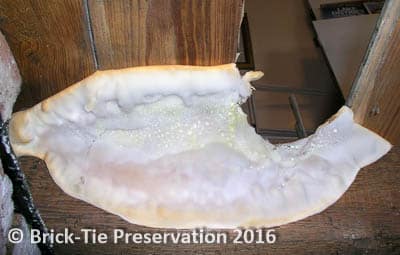
Dry rot thrives on dampness. It can only take hold when damp problems have caused the moisture content of your home’s timbers to elevate to 28% or beyond. To put this in perspective, the ‘normal’, moisture content of wood in a home will be well under 20% and joinery, such as skirting boards and internal doorframes, will be under 12%. Measurement of the moisture content of wood is easy, using a correctly calibrated electronic moisture meter. Our surveyors carry the right type of meter and various accessories to find wood at risk.
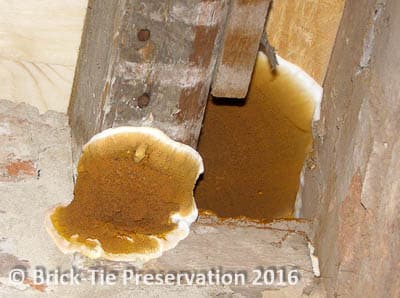
A dry rot outbreak can look remarkable, with extensive growths of white and cream/grey fungus and also strands and orange fruiting bodies. However, by the time this is uncovered, the damage is done. So how can you tell if there may be an earlier stage of Dry rot growing in your home? To help you, we’ve separated the subtle early things to look out for from the actual diagnosis of the fungus directly; it’s better to avoid an outbreak or catch it early and here’s how to do that.
When Should You Book A Survey?
You should arrange a dry rot survey if you notice springy timber floors, distorted skirting boards, a mushroom-like smell, orange dust, visible fungal growth, or signs of long-term dampness near timber. A survey is also recommended after leaks, flooding, roof defects or persistent gutter problems.
Need advice or want to book a survey?
If you suspect dry rot in your home, contact BT Preservation for dry rot survey advice in Yorkshire. Call our friendly team free on Leeds 265 2752, York 566577 or Sheffield 224 5121 or email us via our contact page
and we’ll be happy to help.
Brick Tie Surveys
It may seem obvious but really, the vast majority of dry rot infections are due to basic poor maintenance of homes. Things like blocked gutters, particularly valley gutters or, hidden hard to reach box gutters are often the source of the water, which dry rot craves. Missing lead, slipped slates and long term leaks, which go unnoticed are dry rots best friends. The reason for this is that dry rot, unlike many wet rots, really needs a lot of water. It’s ironic that the name ‘dry rot’ was chosen to describe a fungus that is so thirsty.
It will not spontaneously burst into life because a tap leaked for 5 minutes or, a roof slate blew off in a gale and was replaced the following week. If such temporary wetting was able to support its growth, then it would be very common, which thankfully it isn’t.
To protect your home from Dry Rot or to check for potential sources, or locations of hidden decay, check below:
- Is the roof in sound condition – no missing slates or tiles? If so repair promptly.
- Gutters free of grass and other obstructions, particularly the water bottlenecks at hoppers and where valleys meet gutters? Regular seasonal cleaning is crucial.
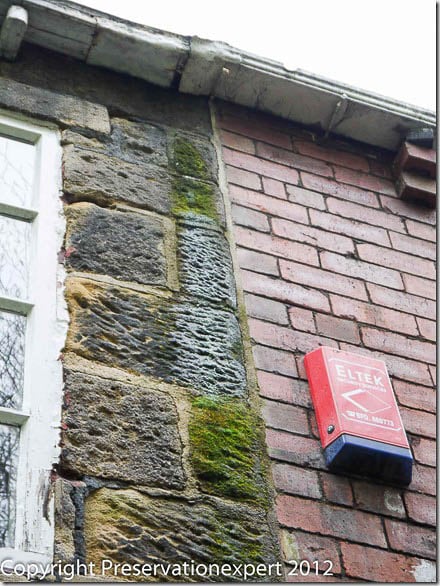
- Any signs of persistent wetting – like green algae or moss stains vertically under gutters, behind rainwater down pipes and such? These indicate leaks and overflows – get them fixed.
- If you have gables with coping stones, what are the joints in them like and are the lead flashings intact? Have a roofer sort these out now.
- Staying at ground level, are the rainwater gullies free of leaves and other debris? Water overflowing from blocked drains is greedily sucked into the base of walls Dry Rot loves this.
- Has any work been done which could reduce sub-floor ventilation, such as extensions and conservatories? If you are unsure we’d recommend a timber survey.
- Moving from the roof – are there overflow pipes poking from the walls outside – you know, from bathroom cisterns and such? Make sure these are fixed if they show any signs of dripping
- If your ground floors are timber, are there air bricks at the base of the walls and are these clear? A bottle brush can help here – get air bricks installed if they are lacking.
- What about the external paths and drives? Home improvements to these, which inadvertently block air bricks are one of the most common causes of Dry Rot.
- Less common but serious risks include flooding and severe water leaks such as burst pipes – always have a timber survey done after these events and do everything possible to promote rapid drying.
Our Accreditations



Indications that there may be a hidden Dry Rot problem at home or in a house you want to buy or sell.
When timber rots is loses weight and size. This is because in effect, parts of the material are being digested for food.
This can reveal itself in a number of ways, which you can see without having to lift floorboards, remove plaster or skirting and other joinery. Of course, you need to take the previous information into account, so normally the area to look at would be that where there is a suspicion of water ingress or a defect, which could promote dampness.
1. One of the most common signs of hidden problems is the faint tinkle of glassware or other items stored in cupboards or display cases and such, when a room with a timber floor is walked into. A heavy gait ‘dropping the heel’ firmly will reveal if the floor is springy at all. Surveyors refer to this as ‘deflection’. If a floor is springy and not completely firm underfoot, further investigation is needed – this could be Dry Rot or a slight defect; check it out.
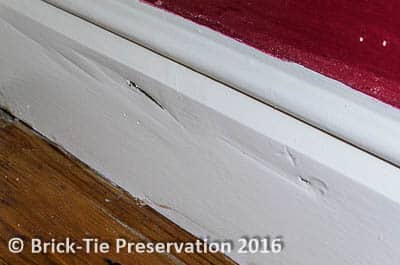
2. Dry rot causes wood to distort and bend as it shrinks. So sometimes you may notice that the surface of joinery tends to show wrinkles in the paint. Look carefully at the image at the top of this page (fig 1), and to the right (fig 4). The skirting board has a paint film with wrinkles. The slow reduction in strength and form gradually pulls the paint so it stretches, rather like wallpaper does.
As the wood develops cracks the paint may still bridge these, but you can see the previously flat surface is bending and distorting – typical of dry rot.
3. If you see these signs, simple probing with a screwdriver will tell you if the wood is sound. If you’re unsure – call us for advice or book a damp and timber survey.
4. If you discover an inexplicable smell of mushrooms or, if you need to wipe away a fine rusty coloured dust from horizontal surfaces, this may also require a survey.
Once Rot is discovered, how to tell which one it is?
There are lots of similarities between the many wet rots and Dry Rot. However only Dry rot will have the following features:
- The white or grey fungal ‘sheeting’ which we call mycelium, can be peeled away from the timber, very like the skin of a mushroom
- Sometimes the fungus seems to weep water as droplets hanging from the fungus – hence the source of Dry Rot’s Latin name
- The fungal strands are flexible when alive, but once dried, they become brittle and ‘snap’ when broken – watch and listen to this in our video below.
- The fruiting body is a spectacular plate or bracket with a red/orange convoluted surface surrounded by a pale edge
- Sometimes the horizontal surfaces near an outbreak get covered by rusty orange dust – these are the millions of spores from a fruiting body, which itself may be hidden from view.
- Often it is accompanied by a strong mushroom smell.
Of course there are other features too: like cube shaped (cuboidal), cracking of the wood as it rots; darkening of the wood and brown or whitish strands; cotton-wool-like growths as well.
However, these are not unique to dry rot and if present, one of our timber experts should be called for an accurate diagnosis. Treating the wrong problem can be expensive and unnecessary, which is why an accurate diagnosis is so important.. It pays to call an expert.
Read on for information on the damage dry rot can cause and how we treat it, or call us for a chat on Leeds 265 2752, York 566577 or Sheffield 224 5121 or email us via our contact page.
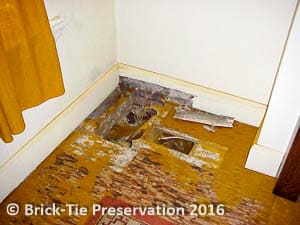
Dry Rot – What’s the damage?
As mentioned above the fungus needs water, so if it is present in a house it will only cause damage in and close to, the damp areas. It has been said that dry rot can spread all over a house like some sort of ‘cancer’ but this is a myth. The only time we ever come across very widespread dry rot in buildings is if there are widespread water sources – for example in derelict buildings with very long-term water ingress at lots of locations. This kind of outbreak is usually the result of dry rot germinating in several locations and merging into what looks like one huge attack. Dry rot spores are everywhere (yes, even in your house now), so if conditions are favourable, these spores will germinate and cause decay.
It is in dry rots nature to thrive in damp, dark and inaccessible locations. So if your property has a damp problem, these areas need opening up, in order to check for dry rot, as well as other rots and infestations. Our timber surveyors have the experience, skills and knowledge needed to trace dry rot when present. Dry rot grows through plaster and masonry, so although it may be initially found in a timber floor, for example, it may spread quite some distance. It can attack other timbers nearby, without any visual evidence. This is why it is best to ask a qualified timber infestation surveyor, such as David Gill or Paul Glover, for advice.
Please remember though, that Dry Rot needs lots of water, so in actual fact the conditions for successful growth in occupied property are rare – don’t have nightmares!
Fast, remedial action from Yorkshire’s rot experts!
Many people assume that rot only appears in old buildings, but we can tell you from experience that there are plenty of newer houses in the areas we serve (Leeds, Sheffield and York to name but a few) that have also fallen victim. A leaking pipe or poor maintenance can bring dry rot calling to any home.
Another common assumption is that dry rot is worse than wet rot, because of its ability to spread and grow through masonry. In fact, the structural issues caused by wet rot can be just as serious. Wet rots cause far more loss overall, simply because they can germinate and grow in dryer conditions than dry rot.
In effect some wet rots can destroy the ground floor in a house, just because the moisture content is above 20% for a very long time. There’s a useful blog post on this below, or visit our page ‘what is wet rot?’ Our damp and timber surveyors are sympathetic and understanding, when they come across a dry rot problem. If a report must contain ‘bad news’ we try to offset this as best we can, with the most cost effective and reliable solutions. Sorting the problem out with minimum fuss at our best prices is our aim. It’s our investment in staff training, combined with decades of experience that ensures that we can deliver on our promises to you.
Use of Chemicals to Kill Dry Rot
Modern, thoroughly tested chemicals have their uses; we try to minimise the application of these as much as possible. In fact, the most effective treatment for dry rot is to eliminate the moisture source and promote rapid drying.
Dry rot hates dry conditions and will die if dampness is eliminated. This is our mantra for killing dry rot for good: “find the cause of the rot and treat that first”. There have been many cases of builders, joiners and less experienced specialist contractors forgetting this simple rule. The result is always the same – failure and a dry rot relapse. If the cause is not found and the moisture source is left unchecked, all the chemicals and well-meaning repairs will be to no avail. If a new floor or replacement timber is merely put into the same damp environment, well, that is ringing the dinner bell for dry rot.
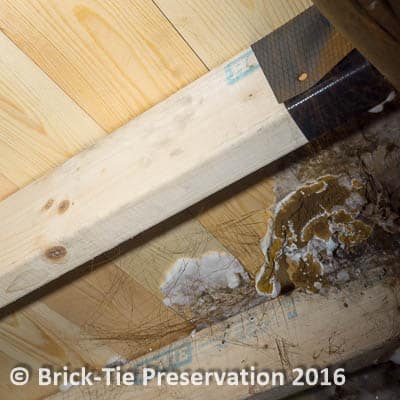
Fig 8 was taken on a dry rot outbreak we were called out to in Sheffield. A new floor was installed a year or so back, and the builder treated the timber and dutifully wrapped the bearing ends in plastic to keep them dry. Note the dry rot fruiting body and active decay and mycelium, already established on the new timbers. This highlights the importance of employing a skilled and qualified expert where dry rot is concerned. Chemicals have their place in dry rot treatment, but good old-fashioned surveying skills, backed up by up-to-date training, are at the heart of successful treatment.
High-quality professional preservatives, used as a supplementary measure to protect timbers during the drying process or to give protection in cases where buildings may remain susceptible to high moisture levels is useful. They also speed up the dry rot eradication process and allow long-term insured guarantees to be issued. Talk to our surveyors if you have any concerns. We want to hear them, and we can virtually eliminate the use of chemicals in many circumstances. However, where they are deemed essential, you can be assured that we use the safest materials; Health and Safety Executive-approved products only. We apply them to award-winning health and safety standards. These standards protect the environment, our employees, you and your family and anyone who might visit your house.
If you suspect that you have dry rot present in your home, please don’t hesitate to call us on Leeds 265 2752, York 566577 or Sheffield 224 5121 or email us via our contact page.
Dry Rot Gallery




Further Reading
The links below lead to a variety of our dry rot learning resources – enjoy!
Can you identify Dry Rot, without a fruiting body to look at? Here’s one way…..snap crackle and pop.
Dry Rot has perhaps the most striking of fruiting body’s – brackets or plates of lovely convoluted and rust coloured sporophores’ which are unmistakable. However, only a mature infection will produce such handy nameplates and sometimes they’ve been removed or are hidden from view… Watch how dry rot can be identified without a fruiting body
Dry Rot Attacking Yorkshire’s Buildings can be Stopped Without Drama
Dry Rot? Just how hard is it to treat? We get lots of calls from clients worried about dry rot treatment. Usually this follows a survey which has suggested dry rot is present in their house, often the survey report will carry dire warnings about the dry rot, resulting in worried homeowners. Read about dry rot treatment in YorkshireContinue reading.
Wet Rot – Dry Rot. Who’s the Daddy?
Okay, so Dry Rot is the bogey man of rots, everyone talks about it and yes, Dry rot is a serious problem. However, it is Wet Rot, in its many forms, which dwarfs the damage done by Dry Rot and is seen in very many older (and some newer), houses. Read about wet rot and dry rot differences.